
- News
- India News
- Keeping tabs on our Tabiyat
Trending
This story is from January 14, 2016
Keeping tabs on our Tabiyat
Health and healing – humanity’s lifelong preoccupations – are at the marrow of ‘Tabiyat: Medicine and Healing in India’. Tabiyat is the spine of Medicine Corner – a multi-arts project across three cities that shows us how hard we’ve strived to stay well.

The connective tissue that joins a platoon of miniature plastic soldiers transfixed in yoga, a pair of 900-year-old Persian medicine jars, an ear scoop, a tongue cleaner, and a 17th century Mughal talismanic tunic may not immediately show itself, but if you gazed hard at the exhibits in the Chhatrapati Shivaji Maharaj Vastu Sangrahalaya in Mumbai, you’ll spot it.

Health and healing – humanity’s lifelong preoccupations – are at the marrow of ‘Tabiyat: Medicine and Healing in India’. Tabiyat is the spine of Medicine Corner – a multi-arts project across three cities that shows us how hard we’ve strived to stay well.
“Medicine Corner investigates how Indian civilization has approached the universal experience of having a mind and body, and how to deal with what goes wrong with them,” says Ratan Vaswani, project head, Medicine Corner, and curator of Tabiyat. The project itself is a product of the Wellcome Trust, a biomedical research charity in London.
The trust has laid a three-fold path to understanding Indian medicinal culture – through a material exhibition (Tabiyat in Mumbai); an art exhibition (Jeevanchakra in Kolkata); and a workshop and live performance by BLOT!, comprising mixed-media artist-duo Avinash Kumar and Gaurav Malaker (Trick or Treat? in Delhi). There will also be tea-tasting sessions, wrestling matches and historical walks through places once beset with the plague. Undergirding this extravagant production is the animal instinct for self-preservation.
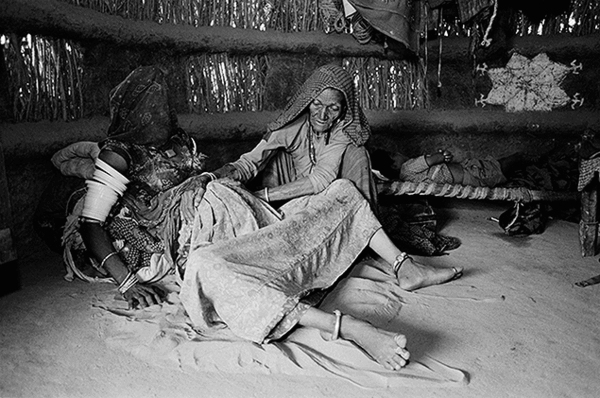
Gauri Gill, Birth Series 1 (From Birth Series 2010), Silver gelatin print. (Image courtesy: Gauri Gill)
BLOT!, for one, has documented the practice and patronage of vernacular healers – bone-setters, Unani practitioners, pavement dentists, sexual health advisors, curers of piles – and other pillars of India’s parallel healthcare. In Old Delhi, for example, they discovered a blood-letter who continues to practise this timeworn detoxification technique by leeching some of his patient’s blood. In Kolkata, an ancient hakim diagnoses a person by studying a day’s worth of his urine, collected diligently in a glass jar.
“Our aim is not to judge the effectiveness of their practices or call the quacks from the genuine healers,” says Avinash Kumar, “but to simply document their existence, and by doing so, legitimize their presence.”
Culturally specific readings of mind and body are at the heart of Jeevanchakra – an exhibition curated by Latika Gupta of photographs, video, paintings and multi-media installations by leading contemporary Indian artists like Nilima Sheikh, Gauri Gill, Sheba Chhachhi, Mithu Sen, Reena Kallat and Paula Sengupta. Gill’s silver gelatin prints capture the moment of birth in village homes in Rajasthan, while Kallat’s videos of patients reading letters on an eye chart at an optometrist’s clinic is a commentary on citizenship, as the falteringly enunciated letters are the disjointed preamble to the Constitution.
In a way, all the strands of Medicine Corner – historic, performative, artistic – come together in Tabiyat, the showpiece in Mumbai. “Tabiyat is a deliberate choice of title,” says Vaswani. “When you ask someone ‘Apki tabiyat kaisi hai?’ you’re not only asking after someone’s physical health but their mental well-being as well.” The word, he says, has travelled via the Persian language from the Arabic. In Arabic it means ‘the nature of things’. “The Islamic meaning borrows from the notion that our god-given bodies possess the internal resilience to heal themselves, and external agents only facilitate that healing,” says Vaswani, who points out that the title also indirectly acknowledges the foreign influences of India’s curative systems.
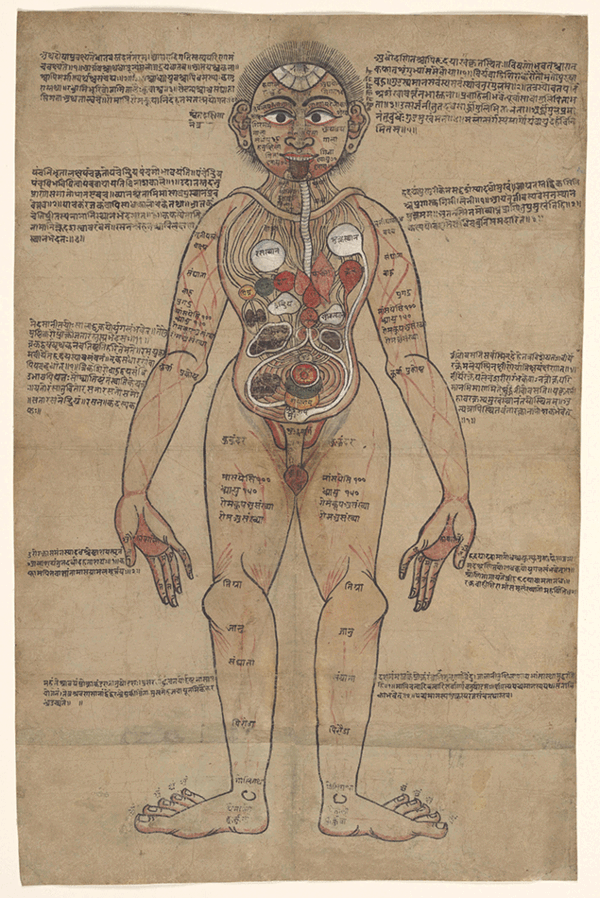
The Ayurvedic Man. A figure showing Ayurvedic understanding of human anatomy, pen and watercolour. Probably 18th Century CE, probably of Nepalese origin. (Courtesy: Wellcome Library, London)
A large part of Tabiyat’s 100-piece collection from the Wellcome Collection in London. These include a fakir’s 19th century nail-embedded sandals; a mid-20th century poster on leprosy; a 19th century brass enema syringe and footscrub; and other rarities. A standout artefact is the ‘tunic taveez’ – an article of Mughal clothing from the 16th or 17th century with Koranic verses inscribed all over it – the idea being, the more of the Koran you could cover yourself with, the better protected you were.
The guiding principle of the curation, says Vaswani, was to draw attention to the curative practices of the home, the street, the shrine and the clinic and to connect history with contemporary practice.
End of Article
FOLLOW US ON SOCIAL MEDIA





Photostories

Hot Picks
TOP TRENDING
Popular Categories
Hot on the Web
Top Trends
Travis KelceIsrael Hezbollah WarIND vs PAK HighlightsElection Exit PollsIND vs BAN Live ScoreKayla NicoleShan MasoodPrince WilliamAmethi Murder CaseAssembly Election Result 2024UGC NET ResultDiddyWomen's T20 World CupTop MBA Colleges of IndiaT20 WC ScheduleWomen T20 World Cup Points TableLive Cricket Score
Trending Topics
Bigg Boss 18 Launch LIVE UpdatesBigg Boss Tamil 8 Contestants ListBigg Boss Tamil 8 Launch LIVE UpdatesNavratri Colours 2024Navratri Day 2 ColourDurga Puja 2024Bigg Boss 18 House PhotoDevara CollectionGOAT OTT ReleaseDeepika PadukoneGovindaDevaraGovinda NewsDevara Movie ReviewSwatantrya Veer SavarkarColdplay India tour 2025Maa Durga 108 NamesNavratri JewellerySony Bravia 55 inch 4k Ultra HD TVWordle Answer
Living and entertainment
Latest News
Long farewell: Yellow alert for today and tomorrowBigg Boss Marathi 5: Riteish Deshmukh condemns Nikki Tamboli and Aarya Jadhao's remarks on Varsha Usgaonkar and Jahnavi KillekarRevealed: The real reason Taylor Swift was missing from Travis Kelce's birthday celebrationDelhi ki festive vibe hi alag hai: Mannara ChopraPunjab AAP leader shot at during argument with Akali Dal leaderWill Varun Dhawan, Shraddha Kapoor, and Kriti Sanon come together in 'Stree' x 'Bhediya' film?Navratri 2024 Day 5: Maa Skandamata, Puja Vidhi, Mantra and SignificanceUttar Pradesh: Police station in-charge and SI suspended, two others removed in BahraichBhumi Pednekar’s Badhaai Do co-star Chum Darang to be a part of Bigg Boss 18? Here’s what we knowBigg Boss Tamil 8: Actress Sachana Namidass to participate in the upcoming season?Amul ready to enter European market after US: MDBigg Boss Marathi 5: Akshay Kumar reunites with Varsha Usgaonkar after 20 years on the reality show; says 'You Haven’t Changed a Bit'Flash flooding kills three in northern Thailand'We just walked the talk': Suryakumar Yadav elated after team executes plans to perfectionOptical Illusion: Can you find who's the boss in this picture?Fans Fume Over Whistle Mania: How the New York Jets' Early Penalty Struggles and Aaron Rodgers' Milestone Ignite Outrage and Calls for Accountability from NFL OfficiatingBigg Boss Tamil 8: Who will be the next host?Bigg Boss Tamil 8: Arun Prasath, the dazzling young actor set to shine in the house
Copyright © 2024 Bennett, Coleman & Co. Ltd. All rights reserved. For reprint rights: Times Syndication Service